
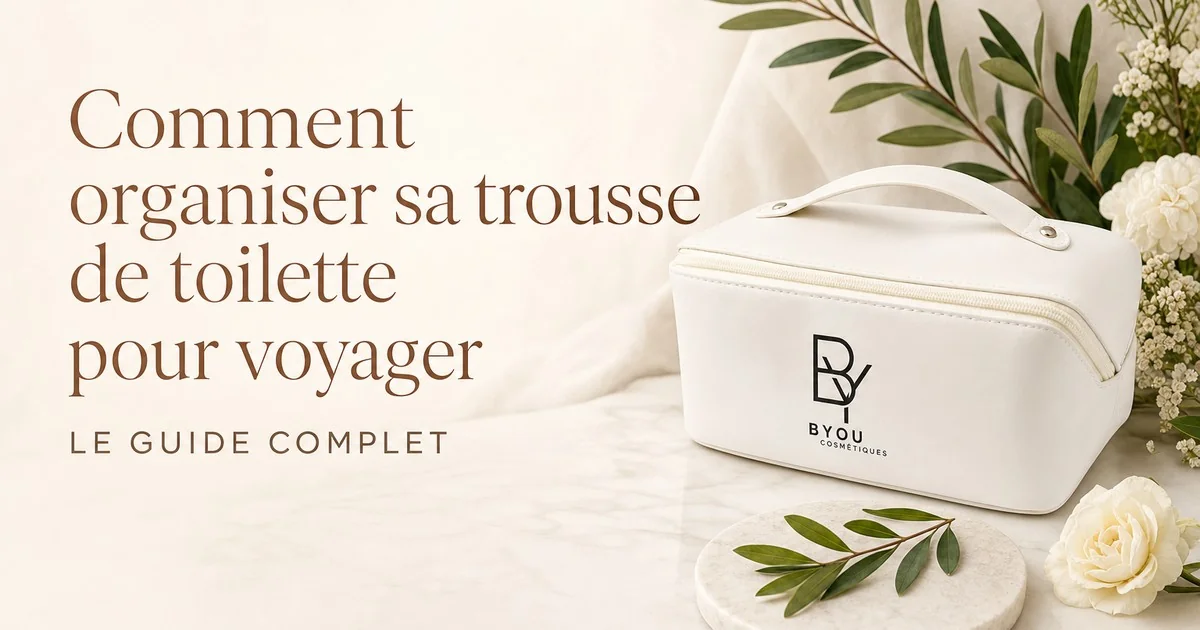
To organise your travel toiletry bag efficiently, start by choosing a waterproof bag with multiple compartments, list your beauty essentials according to the length of your trip, favour travel sizes (100 ml maximum in the cabin), and adopt the vertical storage method: products upright, accessories along the sides. This organisation guarantees quick access to every product and prevents disastrous leaks in flight.
Why does a well-organised toiletry bag make all the difference?
A badly organised toiletry bag is the number one source of stress when travelling. A bottle leaking over your clothes, a cream left at home, or fifteen minutes lost hunting for your serum at the bottom of a bag: these annoyances spoil the start of a trip.
A well-designed bag transforms your beauty routine on the road. You save time every morning, protect your precious products from knocks and get through security checks without a hitch.
- 100 mlmaximum volume per container in the cabin
- 1 litretotal capacity of the clear plastic bag
- 3 minutesaverage time saved each day with an organised bag
Which toiletry bag should you choose to travel with peace of mind?
The choice of bag shapes your entire organisation. Forget small soft pouches that lose their shape the first time you fill them.
Opt for a large-capacity toiletry bag that combines structure, waterproofing and a wide opening. The polyurethane outer material withstands splashes and wipes clean with a cloth, while the polyester lining protects your clothes from any leaks.
The vanity-style flat opening is a game-changer: you can see all your products at a glance, without having to empty half the contents to reach what is hiding at the bottom.
Pro tip
Choose a light colour such as ivory to spot your products instantly in the dim light of a hotel bathroom. Dark shades visually swallow up small bottles.
How do you draw up your list of beauty essentials?
The golden rule: tailor your selection to the length AND the type of trip. A city weekend doesn't call for the same bag as a week at the beach.
The essential-categories method
Mentally divide your routine into five non-negotiable categories:
- Cleansing: soap or cleansing gel, makeup remover if needed
- Hydration: face serum and cream, body oil
- Protection: face and body sun cream depending on your destination
- Hair: shampoo, conditioner or mask, hair oil
- Hygiene: deodorant, toothpaste, toothbrush
For each category, choose ONE multi-purpose product rather than three single-use ones. Pure argan oil moisturises face, body, hair and nails: four steps in one bottle.
The table of suitable sizes by length of trip
| Length of stay | Recommended size | Number of products | Type of bag |
|---|---|---|---|
| Weekend (2-3 days) | Miniatures 30-50 ml | 5 to 7 essentials | Compact cabin pouch |
| One week (4-7 days) | Travel sizes 100 ml | 8 to 12 products | Medium structured bag |
| Two weeks and more | Standard sizes | 12 to 15 products | Large bag with compartments |
| Long stay (1 month+) | Full sizes + refills | 15 to 20 products | Vanity case or two bags |
“A well-organised toiletry bag is 80% preparation and 20% packing. Think usage before you think quantity.”
Which storage method should you adopt inside the bag?
Vertical storage revolutionises access to your products. No more horizontal game of Tetris where everything tips over as soon as you open the bag.
The upright storage technique
Place your pump bottles, precious oils and serums upright at the bottom of the bag. This position stabilises the containers and prevents accidental openings. The heaviest products (creams in jars, glass bottles) go in the centre to balance the weight.
Wedge brushes and accessories along the sides, bristles pointing up. Slip flat products (palettes, soaps) into the side pockets if your bag has them.
Good to know
The polyester lining of a quality bag cleans easily with a damp cloth. A quick clean after each trip extends the life of your beauty accessories.
The zone system by time of use
Organise your bag by routine sequence:
- Morning zone (front): gentle cleanser, hydrating serum, day cream, sun protection
- Evening zone (back): makeup remover, deep cleanser, treatment serums, night cream
- Body zone (left side): body oil, deodorant, hand cream
- Hair zone (right side): shampoo, treatment, hair oil
This mental organisation speeds up your routine: you know exactly where to look depending on the time of day.
How do you protect your products from leaks and knocks?
Leaks when travelling rarely come from a loose cap. It is the cabin pressure that forces liquids out through pumps and soft tubes.
The three foolproof anti-leak steps
Loosen the pumps on your bottles slightly before screwing them back on tightly: this releases the trapped air that expands at altitude. Then wrap each bottle in a small piece of cling film or an individual zip-lock bag.
Place liquid products in the centre of the bag, surrounded by textiles (microfibre towel, soft makeup pouch) that absorb any drops. The waterproof polyurethane material of your main bag forms the final barrier.
For precious oils in glass bottles, add extra protection: slip them into a clean sock before wedging them between two solid products.
Key point
The reinforced zip of a quality structured toiletry bag keeps constant pressure on the contents. This gentle compression stabilises bottles and limits movement during transport.
What alternatives to standard sizes save space?
100 ml travel sizes are still bulky for a weekend. Several solutions optimise space without sacrificing your routine.
Solid products, the space-saving champions
A 60-gram solid shampoo bar is equivalent to 250 ml of liquid shampoo. It doesn't count towards the cabin liquids limit and cannot leak. The same logic applies to face soaps, solid deodorants and toothpaste tablets.
Use a small metal tin to carry these solids: it protects them from moisture and stops them melting against other products.
The liquids vs solids comparison table
| Criterion | Liquid products | Solid products |
|---|---|---|
| Weight for 1 week | 400-500 g | 150-200 g |
| Risk of leaks | Medium to high | None |
| Cabin restriction | 1L plastic bag compulsory | No restriction |
| Length of use | Limited to the size | Equivalent to 2-3x the volume |
How do you adapt your bag to the type of trip?
A business trip, a seaside holiday or a mountain trek impose different constraints. Your bag adapts to each context.
Business trip: efficiency above all
Rely on multi-purpose products and fast-absorbing textures. A hydrating serum replaces day cream + makeup primer. A precious oil nourishes face, hands and hair ends. Limit yourself to 6-8 products maximum in a compact bag that slips into cabin luggage.
Beach holiday: protection first
Double your quantities of sun protection and after-sun. Add a repairing hair oil (salt and chlorine are intensely drying) and a soothing face treatment. Favour refreshing gel textures and opaque bottles that protect the actives from light.
Trek or adventure travel: radical minimalism
Every gram counts. Select 4-5 ultra-versatile essentials: multi-purpose solid soap, pure plant oil (face-body-hair), high-factor sun protection, solid deodorant, toothpaste tablets. Decant into mini containers of 15-20 ml maximum.
Which extra accessories make organisation easier?
Beyond the main bag, a few clever accessories perfect your system.
Refillable mini bottles in soft silicone squeeze to expel air (less pressure in flight) and fill without a funnel. Label them with a permanent marker to avoid mix-ups.
A 30x30 cm microfibre towel slips into the bottom of the bag: it absorbs moisture, protects fragile products and serves as a mat in questionable bathrooms.
A separate small zip-lock bag keeps jewellery and hair accessories together: no more hair ties lost at the bottom of the bag, and your earrings stay in pairs.
“Perfect organisation is the kind that makes you forget you are travelling. Your beauty routine stays the same, wherever you are.”
How do you care for your bag between trips?
A poorly maintained bag accumulates product residue, dust and bacteria. Regular cleaning extends its life and preserves your cosmetics.
After each trip, empty the bag completely. Wipe the polyester lining with a damp cloth to remove traces of makeup or cream. The waterproof material cleans effortlessly: a quick wipe with a sponge is enough.
Leave the bag to dry open and flat for 24 hours before storing it. Absolutely avoid the tumble dryer and direct sunlight, which stiffens polyurethane.
Check the expiry dates of your products every three months: an oxidised serum or a cream that has turned spoils your skin and your trip.
Storage tip
Keep your travel bag stocked with your beauty essentials in travel sizes. Next time you leave, you only add the fresh products (the cream you've started, the serum in use). Time saved: 15 minutes less preparation.
FAQ: your questions about organising a travel toiletry bag
Can you take plant oils in the cabin?
Yes, plant oils (argan, black seed, prickly pear seed) are allowed in the cabin within the limit of 100 ml per container, placed in the one-litre clear plastic bag. Favour plastic or aluminium bottles to avoid breakage: glass is fragile and often refused at security.
How long before departure should you prepare your bag?
Prepare your bag 48 hours before departure. This gives you time to buy a forgotten product or test a new travel size. Check the remaining quantities in each bottle: better to leave with a full product than the end of a tube that runs out on day three.
Do you need a different bag for summer and winter?
No, keep a single basic bag and adapt the contents to the season. In summer, add high-factor sun protection and soothing after-sun. In winter, step up the nourishing products (balms, rich oils) and lip protection. The structure of the bag stays the same: only 2-3 products change.
How do you organise a family toiletry bag for 4 people?
Opt for a large bag with multiple compartments or two medium bags (adults / children). Share the neutral products (soap, mild shampoo, sun protection) and separate the specific items (makeup, shaving, targeted face care). Label each section clearly so everyone can find their way instantly.
What is the average lifespan of a quality toiletry bag?
A quality bag with a reinforced zip and hard-wearing lining lasts 5 to 7 years with regular use (4-6 trips a year). The waterproof material ages better than fabric: it doesn't stain, doesn't go mouldy and keeps its structured shape. Caring for it after each trip (cleaning, drying completely) maximises this lifespan.
